
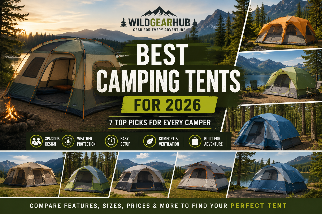
Choosing the best camping tents can make a huge difference in how comfortable and enjoyable your outdoor trip feels. The right tent should give you enough sleeping space, protect you from changing weather, provide adequate ventilation, and be practical enough to set up at your campsite.
But there isn't one perfect tent for everyone.
A couple going on weekend car-camping trips may want a compact 2-person tent, while a family might prefer a spacious 6- or 8-person model. Tall campers may prioritize peak height and floor length, while budget-conscious shoppers may care more about simple setup and overall value.
In this guide, we've compared several popular camping-tent options and explained what to look for before buying. We'll focus on capacity, space, weather protection, setup, ventilation, portability, and intended use so you can choose a tent that actually fits your camping style.
Editor's Note: Product specifications, availability, and prices can change. Always verify the current specifications and price on the retailer's website before purchasing.
Best Camping Tents at a Glance
| Tent | Best For | Capacity | Key Advantage |
|---|---|---|---|
| REI Co-op Westward 4 | Best Overall | 4-person | Space & wind performance |
| The North Face Wawona 6 | Best Family Tent | 6-person | Large interior & vestibule |
| REI Co-op Base Camp 4 | Small Groups | 4-person | Weather protection & storage |
| Zempire Aerospeed 6 Air | Maximum Space | 6-person | Huge interior |
| Gazelle T4 Hub | Fast Setup | 4-person | Quick pop-up design |
| Kelty Discovery Basecamp 6 | Best Value | 6-person | Affordable large tent |
| Coleman Sundome | Beginners | 2–4 person | Simple setup & accessible design |
The first six tents above are current options highlighted in REI's 2026 tested camping-tent guide; the Coleman Sundome is included here as a beginner-oriented option with a long-running, straightforward dome-tent design.
1. REI Co-op Westward 4 — Best Overall


If you want a well-rounded tent for car camping, the REI Co-op Westward 4 is one of the most interesting current options.
REI's 2026 testing gave the Westward 4 a 95/100 score and Editors' Choice Award. It has 68 square feet of floor area, a 69-inch peak height, two doors, a 20.27-square-foot vestibule and a packaged weight of about 15 pounds 7 ounces.
One of its standout characteristics is its performance in windy conditions. REI testers reported that it remained stable during testing that included gusts reaching 30 mph.
Key Features
- 4-person capacity
- 68 sq. ft. floor area
- 69-inch peak height
- 2 doors
- 20.27 sq. ft. vestibule
- Approximately 15 lb. 7 oz. packaged weight
- Strong wind performance in REI testing
Pros
- Spacious interior
- Good headroom
- Two doors
- Useful vestibule
- Strong performance in wind testing
Cons
- Not a lightweight backpacking tent
- Premium price
- More tent than solo campers need
Best For
Car campers, couples, small families, and taller campers who want extra room.
Amazon: [Check Latest Price →]
2. The North Face Wawona 6 — Best Family Camping Tent


5
For family camping, interior space becomes extremely important.
The North Face Wawona 6 provides 86.11 square feet of floor area plus a large 44.7-square-foot vestibule, giving campers plenty of room for people and gear. REI lists a 76-inch peak height, two doors, and a packaged weight of approximately 19 pounds 1 ounce.
The large vestibule is particularly useful because it gives you a covered area for gear without taking away from the sleeping space.
Key Features
- 6-person capacity
- 86.11 sq. ft. floor area
- 44.7 sq. ft. vestibule
- 76-inch peak height
- 2 doors
- Approximately 19 lb. 1 oz. packaged weight
Pros
- Large sleeping area
- Excellent vestibule space
- Tall interior
- Good option for families
- Plenty of room for camping gear
Cons
- Heavy
- Large packed size
- More tent than a couple may need
Best For
Family car camping, tall campers, and groups that bring lots of gear.
Amazon: [Check Latest Price →]
3. REI Co-op Base Camp 4 — Best for Small Groups


4
The REI Co-op Base Camp 4 is designed for campers who want a relatively compact four-person shelter with features that help it perform in changing conditions.
REI lists 59 square feet of floor area, a 63-inch peak height, two doors and a packaged weight of approximately 17 pounds 6 ounces. It also has two vestibule areas, listed as 23 and 15.5 square feet.
The tent also includes multiple ventilation features, including four roof vents, according to REI's testing guide.
Key Features
- 4-person capacity
- 59 sq. ft. floor area
- 63-inch peak height
- 2 doors
- Two vestibule areas
- Multiple roof vents
- Approximately 17 lb. 6 oz. packaged weight
Pros
- Good weather-oriented design
- Two doors
- Useful vestibule space
- Good ventilation
- Suitable for small groups
Cons
- Heavy compared with backpacking tents
- Interior is smaller than some 6-person tents
Best For
Small families, couples, and campers who want a more weather-focused car-camping tent.
Amazon: [Check Latest Price →]
4. Zempire Aerospeed 6 Air — Best for Maximum Space


4
If interior space is your number-one priority, the Zempire Aerospeed 6 Air is worth a look.
It offers 95.5 square feet of floor area, an 80-inch peak height and two 18.1-square-foot vestibules. REI lists a packaged weight of approximately 19 pounds 12 ounces.
Instead of conventional tent poles forming the main frame, the Aerospeed uses an inflatable frame. REI's testers found that it could be inflated in less than two minutes using the included pump and were pleasantly surprised by its stability in fair-weather conditions.
Pros
- Extremely spacious
- Very tall interior
- Two vestibules
- Fast inflation
- Excellent for comfortable car camping
Cons
- Expensive
- Large packed size
- Not ideal for backpacking
- Inflatable structure adds a different setup process
Best For
Large groups and campers who prioritize living space and comfort.
Amazon: [Check Latest Price →]
5. Gazelle T4 Hub Tent — Best for Fast Setup


4
Some campers simply don't want to spend 20 or 30 minutes assembling tent poles.
That's where a hub-style tent can make a big difference.
The Gazelle T4 Hub is designed for fast setup. REI testers reported that the tent could be raised extremely quickly once it was unrolled and positioned. It offers 61 square feet of floor area, a 78-inch peak height, two doors and weighs around 30 pounds.
The biggest tradeoff is obvious: the convenience comes with substantial weight and packed size.
Pros
- Very fast setup
- Tall interior
- Two doors
- Good ventilation and windows
- Convenient for frequent car campers
Cons
- Heavy at around 30 pounds
- Large packed dimensions
- Not suitable for backpacking
Best For
Families and car campers who prioritize easy setup over portability.
Amazon: [Check Latest Price →]
6. Kelty Discovery Basecamp 6 — Best Budget-Friendly Option


You don't always need an expensive tent to enjoy comfortable car camping.
The Kelty Discovery Basecamp 6 is designed for campers who want a larger tent without spending as much as they might on premium models.
REI's 2026 testing lists 88 square feet of floor area, a 68-inch peak height, one door and a packaged weight of approximately 13 pounds 14 ounces.
REI describes it as a budget-conscious option for larger groups. In testing, a family of six found it comfortable, and the tent handled a night with two inches of rain.
Pros
- Large interior
- Relatively light for its size
- Affordable positioning
- Easy setup
- Good choice for families
Cons
- Fewer premium features
- Only one door
- Less feature-rich than premium alternatives
Best For
Budget-conscious families and larger camping groups.
Amazon: [Check Latest Price →]
7. Coleman Sundome — Best for Beginners


6
If you're buying your first camping tent, a simple dome design can be a smart place to start.
The Coleman Sundome has been designed around straightforward setup and warm-weather camping. Earlier Amazon product information describes features including large windows, a ground vent, WeatherTec construction, a rainfly and an expandable carry bag.
Because Coleman sells different Sundome sizes and versions, check the exact model's current capacity and specifications before buying.
Pros
- Beginner-friendly design
- Simple dome shape
- Ventilation features
- Widely recognized camping option
- Available in multiple sizes
Cons
- Less spacious than larger family tents
- Better suited to casual camping than demanding conditions
- Specifications vary by model
Best For
First-time campers, casual weekend trips, and warm-weather camping.
Amazon: [Check Latest Price →]
How to Choose the Best Camping Tent
Buying a tent based only on the number of people printed on the package isn't enough.
Here are the most important things to consider.
1. Choose the Right Tent Capacity
Tent capacity is usually expressed as:
- 2-person
- 3-person
- 4-person
- 6-person
- 8-person
But don't assume that a "4-person" tent will necessarily be comfortable for four adults.
Tent capacity is generally based on how many people can fit inside sleeping relatively closely together. REI recommends thinking of the stated capacity as a maximum and sizing up if you want more space for gear or dogs.
A useful rule:
2 people + lots of gear → consider a 3- or 4-person tent.
4 people + gear → consider a 6-person tent.
6 people + gear → consider an 8-person tent.
Extra space can make a huge difference during rainy weather when everyone has to spend more time inside.
2. Consider Floor Area
Floor area tells you much more than the simple "4-person" or "6-person" label.
For example, REI's 2026 tested options range from 59 square feet for the Base Camp 4 to 95.5 square feet for the Zempire Aerospeed 6.
If you're camping with:
- Large sleeping pads
- Air mattresses
- Dogs
- Children
- Lots of backpacks
- Camping gear
you'll probably appreciate more floor space.
3. Check Peak Height
Peak height is especially important for taller campers.
A taller tent makes it easier to:
- Sit upright
- Change clothes
- Move around
- Enter and exit
- Spend time inside during bad weather
REI notes that taller walls provide more headroom but can also be more exposed to wind.
So don't automatically choose the tallest tent available.
4. Look at Floor Length
If you're over 6 feet tall, floor length deserves special attention.
REI recommends considering a floor length of around 90 inches if you're tall or simply want more room to stretch out.
Before purchasing, check the actual floor dimensions rather than relying only on the advertised capacity.
5. How Many Doors Do You Need?
Door count might seem like a minor feature until you're camping with multiple people.
With one door, the person sleeping farthest from the entrance may need to climb over others to get outside.
Two doors can make nighttime bathroom trips much easier.
For couples and families, multiple doors can therefore be worth paying extra for.
6. Don't Ignore the Vestibule
A vestibule is covered space outside the main sleeping area.
It's extremely useful for storing:
- Hiking shoes
- Backpacks
- Wet clothing
- Camping equipment
- Small outdoor gear
The major benefit is that your gear can stay outside the sleeping area without being completely exposed to rain.
The North Face Wawona 6, for example, has a particularly large vestibule area according to REI's current specifications.
7. Think About Weather Protection
A tent should match the conditions you're likely to encounter.
For typical three-season camping, look for:
- Full or substantial rainfly
- Sealed/taped seams
- Waterproof floor construction
- Good ventilation
- Strong stakes and guy-out points
- Appropriate pole/frame design
For more severe winter conditions, a dedicated 4-season tent is usually more appropriate.
REI notes that 3-season tents are designed for most of the year with ventilation and protection from basic downpours, while 4-season tents are built for stronger winds and more severe weather.
8. Ventilation Matters More Than You Think
A tent can protect you from rain while still becoming uncomfortable if airflow is poor.
Look for:
- Mesh windows
- Roof vents
- Adjustable vents
- Multiple doors
- Mesh panels
Good ventilation can help reduce condensation and keep the interior more comfortable.
However, opening vents during bad weather may need to be balanced against keeping rain out.
9. Consider Setup Time
If you're arriving at camp late after a long drive, complicated tent setup can become frustrating.
Ask yourself:
How often do I camp?
How many people will help with setup?
Will I arrive in daylight or after dark?
A conventional pole tent can be a good choice for campers comfortable with setup.
A hub or inflatable tent may be worth considering if setup speed is a priority.
The Gazelle T4 Hub, for example, is specifically appealing because of its rapid setup design, although its approximately 30-pound weight makes it much more suitable for car camping than backpacking.
Car Camping vs. Backpacking Tents
This is one of the most important distinctions to understand.
Car-Camping Tents
Typically:
- Larger
- Heavier
- More spacious
- More comfortable
- Easier to set up
- Better for families
Your vehicle carries the weight, so you can prioritize comfort.
Backpacking Tents
Typically:
- Lighter
- Smaller
- More compact
- Designed to be carried long distances
- More expensive for the amount of space provided
REI notes that weight and packability are much less important for car camping because the vehicle handles most of the transportation.
Don't buy a 20–30 pound family tent if you plan to carry it several miles on a trail.
3-Season vs. 4-Season Tents
3-Season Tent
Best for:
- Spring
- Summer
- Fall
- Typical rain
- Most recreational camping
They generally emphasize ventilation and reasonable weather protection.
4-Season Tent
Designed for:
- Winter camping
- High winds
- Snow
- More severe conditions
They generally use more robust structures and less mesh, which can make them warmer but less ventilated in mild weather.
For most casual campers, a good 3-season tent is the more practical choice.
What Size Tent Should You Buy?
Here's a simple starting point:
| Camping Group | Comfortable Starting Point |
|---|---|
| 1 person | 2-person |
| 2 people | 3–4 person |
| 3 people | 4–6 person |
| 4 people | 6 person |
| 5–6 people | 6–8 person |
| Large family | 8+ person |
These aren't strict rules. Your preferred sleeping arrangement, gear, pets, and how much time you expect to spend inside should influence the final decision.
What Else Should You Buy With a Camping Tent?
A tent is only one part of a comfortable camping setup.
Consider adding:
Sleeping Pad
Provides insulation and cushioning from the ground.
Sleeping Bag
Choose one appropriate for the temperatures you'll encounter.
Tent Footprint
Can help protect the tent floor and keep it cleaner.
Tent Stakes
Useful for securing the shelter, particularly in wind.
Headlamp
Much more convenient than trying to use a flashlight while setting up camp.
Camping Chair
After setting up your tent, you'll probably want somewhere comfortable to sit.
If you're a larger camper, our previous guide may help:
[Best Camping Chairs for Heavy People]
This will become an important internal link between your first and second articles.
Common Camping Tent Buying Mistakes
Mistake #1: Buying Based Only on Capacity
A 6-person label doesn't tell you everything.
Check:
- Floor area
- Floor dimensions
- Peak height
- Vestibule space
- Door count
Mistake #2: Buying Too Small
Many first-time campers underestimate how much space their sleeping gear takes.
A tent that fits four people tightly may feel much better with two or three people.
Mistake #3: Ignoring Packed Weight
A 30-pound tent may be perfectly reasonable for car camping.
It's a terrible choice for carrying several miles.
Mistake #4: Forgetting Gear Storage
A tent might have plenty of sleeping space but nowhere to put wet shoes and backpacks.
A vestibule can solve that problem.
Mistake #5: Ignoring Ventilation
A waterproof tent with poor airflow can become humid and uncomfortable.
Look for mesh panels and adjustable vents.
Final Verdict: Which Camping Tent Should You Buy?
The best camping tents depend heavily on your camping style.
🏆 Best Overall
REI Co-op Westward 4
A strong all-around choice for car campers who want space, headroom and good weather performance. REI's 2026 testing gave it the highest score in its tested lineup.
👨👩👧👦 Best for Families
The North Face Wawona 6
Its large floor area and substantial vestibule make it especially attractive for families and campers carrying lots of gear.
💰 Best Budget-Friendly Choice
Kelty Discovery Basecamp 6
A practical option for campers who want a large tent without moving immediately into premium pricing.
⚡ Best for Fast Setup
Gazelle T4 Hub
A strong option if you value fast setup and mostly camp where your vehicle can reach the campsite.
🏕️ Best for Maximum Space
Zempire Aerospeed 6 Air
A spacious option for campers who prioritize comfort and living space.
🌲 Best for Beginners
Coleman Sundome
A straightforward option for people getting started with casual camping.
Frequently Asked Questions
What is the best camping tent for beginners?
A simple dome-style tent such as the Coleman Sundome can be a practical starting point because the design is straightforward and familiar. Always check the exact model and current specifications before purchasing.
Is a 4-person tent big enough for four adults?
Technically, a 4-person tent can accommodate four people, but it may feel crowded, especially if everyone has bulky sleeping gear. If you want more comfort, consider sizing up to a 6-person tent.
Is a 6-person tent good for a family of four?
Yes. A 6-person tent can provide a useful amount of extra space for a family of four, particularly if you need room for clothing, bags and other camping equipment.
What is the best tent for rainy weather?
Look for a tent with a full rainfly, waterproof floor construction, good seam protection, adequate ventilation and a sturdy structure. No recreational tent should be treated as completely immune to severe weather.
Are expensive camping tents worth it?
They can be, especially if you camp frequently and value durability, easier setup, better materials, more space or stronger weather performance. Occasional campers may find a simpler tent perfectly adequate.
Should I buy a 3-season or 4-season tent?
For most recreational spring, summer and fall camping, a 3-season tent is usually the practical choice. If you specifically plan to camp in winter conditions, heavy snow or strong winds, consider a purpose-built 4-season shelter.
Amazon Affiliate Disclosure
As an Amazon Associate, WildGearHub earns from qualifying purchases.
Some links on this page may be affiliate links. If you purchase through one of these links, we may earn a commission at no additional cost to you.
Prices, availability, specifications, ratings and product features can change. Always verify the current information on the retailer's website before purchasing.